THE TRADITIONAL and CLASSIC KORAT FAQs
Traditional Korat Breeders
|
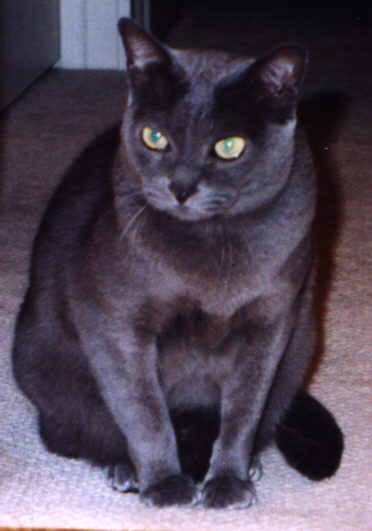
Brett
Traditional Korat
Courtesy of
Ms. Susanne Singer
|
 Chiang
Mai Korats Chiang
Mai Korats
Classic Korat
Photo by
Jakkapat Kangwan
Courtesy of Martin Clutterbuck's
"The Legend of Siamese Cats"
|
Q: What is the History of the Traditional and Classic KORAT?
A: Much of the history we present comes from the "Cat Book Poems"
and other information as provided in Martin Clutterbuck's
book
"The Legend of Siamese Cats", e-mail: martin@amanuensis.th.com.
To order contact Martin at
62/35 Soi Rung Petch
Bangkhunn ond Bangkok Noi
Bangkok Thailand 10700 )
"Grace of the Maaleht, its body evenly coloured
Fur like the Lao flower, smooth
Fur roots a cloudy grey, off white
Eyes as dewdrops on a lotus."
ALSO:
"One lao flower of clear colour, off white, see black mixed
Who finds one, hurry to support it, that cat brings happiness
Women, men everywhere will cherish it, as this cat has charm
Loved all over by the people, both female and male."
ALSO:
"Soft fur of the colour of Dork Lao-claws and eyes a fine white
Dewdrops of eyes, an arresting welcome call.
If any man or woman feeds it, this must be every day and night
And all kinds of property falls to them."
ALSO:
"The fourth, Dork Lao (flower) is yet greater, of sharp
comeliness, with no pattern intermixed, the eyes white as dust,
unstained, in whoever's house, even a bad fall comes good, with
elephants, horses, slaves and men, with contentment and enjoyment."
Also:
"White Dork Lao straight..
hite and black mixed, interleaved, all...
White claws and whiskers, do not doubt, all white
White eyes of hidden charm, an arresting echoing call."
ALSO:
"Whichever cat is beautiful as a fine Lao flower
the cat's eyes are like dew, looking fine
giving luck for you to hear, its loud cry is tuneful and proud
for whoever cares, there is merit, so if obtained, an
abundance of lovers, a multitude of slaves."
A verse by Khun Prasit Sahakorn, more recently, translates like this:
"The cat Maled has a body color like Doklao.
The hairs are smooth, with roots like clouds and tips like silver.
The eyes shine like dewdrops of a lotus leaf."
"Maled" means seed. "Dok" means flower, and "lao"
means reed blossom, lemongrass, or pampas grass. These are very smooth, and
silvery, so they apply to the Korat coat.
In the folded book called the "Smud Khoi of Cats", I mentioned
earlier, (in his book) the Korat is the fourth drawing down from the top. It is
also pictorially represented on blackened Khoi paper in another ancient text.
King Rama V is historically credited to naming the breed when he asked.
"What a pretty cat. Where is it from? When he was told, "From
Korat", thus came the name. Tradition states that their coloring
camophlaged them in the granite areas of the Pimai District and protected them
from extinction due to the constant wars between Siam and its neighbors for
decades. They are known to have lived in the jungles of the Malay Peninsula
across the isthmus of Kra.
Courtesy of Martin Clutterbuck.
In modern day Thailand the Korat is referenced as the Si-Sawat (see-sah-waht).
Now they are found in other provinces than just Korat. "Si" means
color. "Sawat" means prosperity or good fortune. The Si-Sawat name has
components meaning a mixed color of light green and grey. A seed (ma-led) of the
look Sawat is a wild, non-edible fruit growing in Thailand that is of this
mingled color with a glossy, smooth shell.
Since each hair is tipped with silver, causing a shining, halo effect all
over the cat, this highly prized tipping is called "sea foam" by the
Thais.
Testimonials of their existence came from a 1906 visitor to Thailand from New
York, NY by the name of Mr. Robins, who saw the Korat cat in the Province of
Korat at that time. In the early 1900's they are referenced in "Pet
Digest" as "all blue Siamese" being kept in the U.S. The Adviser
in Fisheries to His Siamese Majesty's Government, Dr. Hugh M. Smith from 1923 to
1934 must have seen them because he was quoted in "Siamese Cats, published
in 1948 by Sydney W. France. Their sighting was reported by Mr. Russell in
Kathleen Williams' 1950 book entitled, "The Breeding and Management of the
Siamese Cat". C.A. House wrote in Cats: Show & Pet , second edition in
1912 and Our Cats And All About Them (1930) about Mr. Spearman, a young
Englishman just home from Siam who exhibited a Blue Siamese at a National Cat
Club show held in the grounds of Holland House, London in 1986. "This cat
was blue instead of biscuit colour, as were the majority of Siamese which we had
seen up to that time. And Mr. Louis Wain, who was judging, refused to recognize
it as a Siamese and left it out. He argued with Mr. Spearman that it was not a
Siamese but that gentleman said it was and that there were others in Siam from
where he had previously brought it."
Good fortune surrounds the Korat according to the Thai people. The gift of a
pair of Korats to a high born, new bride is supposed to ensure a fortunate
marriage. The color of their eyes is the color of young rice, and their body
color is the same as rain clouds, representing good crops. Their silver tipping
denotes wealth. Rarely are they sold because the Thai people hold them in such
high esteem.
The first recorded pair of Korats to have been imported into the U.S. for
breeding were given as a giftto Mrs. Jean L. Johnson of Cedar Glen in Gresham,
Oregon in June, 1959. Nara and Darra came from Mme. Ruen A. Rajamaitri's Mahajay
Cattery in Bangkok. Many years later two more were imported to the U.S.
Eventually those serving our government in Thailand came home with even more.
All Korats must track their pedigrees back to Thailand to be considered a
purebred or authentic Korat. Due to this requirement it has become known as
"The cat with the Thai Passport".
A Korat group was formed in 1965. By 1966 they were accepted and being shown
by CFA.
They are not talkative as the Siamese. Instead they greet their owner and
offer a "hurry up and feed" me notice. Preferring their own kind, they
still can blend into multi-breed households, with an attitude of wanting to
dominate in order to receive maximum attention.
|
 The
Traditional Cat Association,
Inc.©1987®TM
Official Website
The
Traditional Cat Association,
Inc.©1987®TM
Official Website